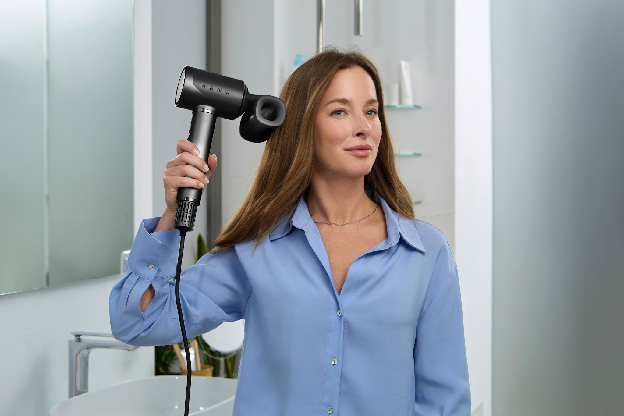
A hair dryer is one of those things you buy once every few years — and then regret the choice every single morning. Let's break down what actually matters when buying one in 2026: which features genuinely affect styling quality and hair health, which technical specs are worth checking, and how much it's reasonable to pay.
What Features to Look For
Temperature control. A basic hair dryer just blasts hot air. More advanced models can track the airflow temperature and keep it within set limits so hair doesn't get overdried. A step further are sensors that account for the distance to your hair and adjust heat in real time — the closer the dryer gets, the more the heat needs to drop to keep the effect on your hair consistent.
Ionization. A stream of negative ions neutralizes the static electricity that makes hair frizz up and fly around. The result is smoother styling and noticeably more shine, especially on fine or curly hair.
Auto shut-off / smart pauses. A feature that detects when the dryer is set down and automatically stops the airflow, then resumes it the moment you pick it up again. It saves energy, extends motor life, and spares you the habit of constantly flicking the switch on and off.
Voice or touch control. In 2026 this is no longer a gimmick — it's a way to switch between modes quickly without breaking your styling flow, especially handy when one hand is busy with a brush.
Magnetic nozzles. Quick swaps between a concentrator, diffuser, brush attachment, or coanda-effect nozzle without wrestling with a mount — saves time and patience, especially for multi-step styling.
Noise level. Dryers in the 1500–2200 W range can be either deafening or perfectly comfortable, depending entirely on motor design. If you plan to dry your hair early in the morning or late at night, it's worth checking noise levels separately.
Weight and ergonomics. For longer styling sessions, 500–650 g is the sweet spot — heavier models tire out your arm fast.
Which Technical Specs to Pay Attention To
| Spec | What matters |
|---|---|
| Power | 1400–2200 W is the optimal range for home use. More power means faster drying, but it isn't always better for hair without proper temperature control. |
| Motor type | A brushless motor lasts longer, runs quieter, and delivers a more stable airflow compared to a classic brushed motor. |
| Airflow speed | Measured in km/h; the higher it is, the faster the drying at the same power level. |
| Number of speed and heat settings | At least 2–3 speeds and several temperature modes — needed for different hair types and styling stages. |
| NTC sensor | A sensor that tracks airflow temperature in real time and prevents hair from overheating. |
| Ionization | A definite plus for smoothness and shine, especially for porous or damaged hair. |
| Cord length | At least 1.8 m, so you're not doing a dance around the mirror to reach the outlet. |
| Weight | Up to 650 g for comfortable extended use. |
| Included accessories | A set of nozzles (concentrator, diffuser, quick-dry attachment) expands functionality without buying separate tools. |
Pricing: What a Good Hair Dryer Costs in 2026
The market roughly splits into three price tiers:
- Budget (up to ~€20): simple dryers with no sensors or ionization, noisy, often without temperature control. They dry hair — and that's about it.
- Mid-range (€20–60): ionization shows up, along with multiple speed and heat settings, quieter motors, and magnetic nozzles. This is where most "smart" AI-powered dryers live — the sweet spot between price and technology.
- Premium (€60 and up): proprietary hair-care technologies (infrared light, patented temperature-control algorithms), branded design, expanded accessory sets, and longer warranties.
A sensible strategy is to avoid overpaying for a name and instead look at the actual feature set: a temperature sensor, ionization, a brushless motor, and a reasonable noise level often matter more than a loud logo on the box.
A Case Study: The AENO HD5 AI ProDryer
The AENO AI ProDryer HD5 is a good benchmark for what the mid-range segment currently offers in terms of AI-driven features.
What's inside:
- 1500 W of power, motor speed up to 110,000 rpm, airflow up to 180 km/h — fast drying without the wait.
- Patented AI temperature control — the dryer tracks the distance to your hair and adjusts heat so the temperature stays consistent on the hair, not just at the nozzle.
- NTC sensor for additional real-time overheat protection.
- Start-Stop technology — automatically pauses when the dryer is set down and instantly resumes when picked back up, saving energy and motor life.
- Ionization — fights static and frizz for a smoother, shinier finish.
- Voice control across AI, Soft, Hot, and Cold modes, plus a touch display for precise adjustments.
- InfraCare technology based on 490 nm infrared light, claimed to improve hair condition with regular use.
- 5 magnetic nozzles (concentrator, quick-dry, coanda, brush, diffuser) for any styling need.
- Just 600 g and a quiet brushless motor (up to 74 dB) — comfortable for daily use, even late at night.
- Includes a travel case for storage and transport, a 2 m cord, and a 24-month warranty.
This is a case where the mid-range price tier packs in nearly the entire premium-class feature set: smart temperature control, ionization, a brushless motor, and a thoughtfully designed accessory kit.
Conclusion
Running through the checklist from this guide — temperature control, a brushless motor, ionization, sensible weight, and noise level — the AENO HD5checks nearly every box without stepping into premium pricing. AI-driven heat control and the NTC sensor look after your hair, the magnetic nozzles cover every styling scenario, and the lightweight brushless motor makes it an easy pick for everyday use.
👉 For full details and specs, see the product page: AENO HD5B AI ProDryer





Feedback Junction
Where Thoughts and Opinions Converge