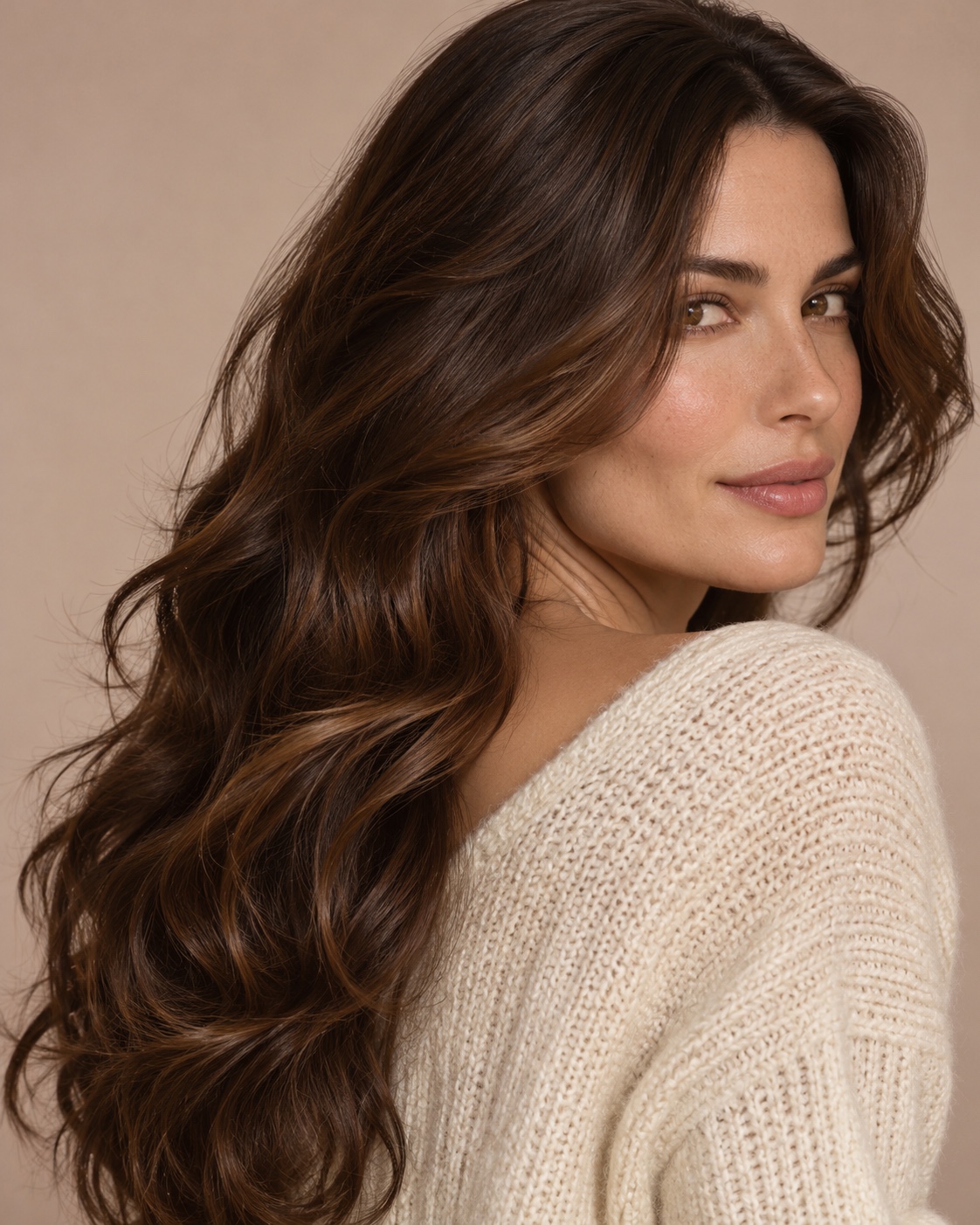
Espresso brown is a deep brunette with a little golden warmth, rather than an inky black or a deliberately gray finish. The appeal is the combination: dark enough to look rich, soft enough to show movement. You should still be able to see that it is brown when daylight reaches the lengths.
That description leaves room for your starting color, texture and preferences. A photo of glossy waves is a useful reference, but it cannot tell a colorist what is already on your hair or how much upkeep you want. Before booking, compare the different brunette directions, work out what to ask at your consultation, and decide whether the maintenance routine fits your life.
The goal is a color you like in ordinary light, with your usual styling, rather than a salon photograph you can only recreate with professional lighting. This guide gives you language for that conversation without turning a shade name into a do-it-yourself chemical formula.
What makes espresso brown different?
Colorist Nataly Maldonado describes espresso in Allure's shade guide as a dimensional deep brown with a golden reflection. The same report recommends asking a professional about the starting base and describes gloss appointments roughly six to eight weeks apart, with less heat between visits. Those are colorist guidelines, rather than a universal timetable.
Think of the word espresso as a visual direction. It does not identify one standardized shade across every salon or dye range. One reference might have a warm chestnut sheen; another might look almost black indoors. Show your colorist what you mean by deep, warm and dimensional instead of assuming those words mean the same thing to everyone.
Bring an example you dislike as well as one you love. Saying that you want warmth without an obvious copper cast can be more useful than asking for an expensive-looking brunette. Ask to view swatches near a window when possible, and talk about how the color will read with your natural texture.
Thanks for your feedback! Couldn't send feedback. Try again?
Report this addition
Compare espresso with other brunette directions
These are visual descriptions for a consultation, not exact salon formulas.
Direction
What you are asking to see
Espresso brown
Deep brown with subtle warm reflection and movement
Cherry cola
A brunette base with a clearer red or burgundy emphasis
Bronde
A more visibly mixed brown-and-blonde result
Near-black
A darker, inkier overall impression
Ashy dark brown
A cooler, muted impression with less golden warmth
You do not need to pick the deepest option to make a change. If you like your current brunette but want it to look more intentional, ask whether adjusting tone would achieve the effect before discussing a larger color change. If the inspiration is mostly about shine, separate that from the question of depth: a reflective finish and a darker shade are different requests.
A quick reference-photo test
Look at the roots, the mid-lengths and the ends in your chosen photograph. Are they one shade, or can you see lighter pieces? Is the shine coming from a strong light source? Is the model's hair straight, waved or tightly curled? Those details can change the overall impression without being part of the dye color itself.
Save a small set of references that agree with each other. A folder containing black hair, copper hair and bright caramel highlights may leave the colorist guessing which feature you actually want.
Thanks for your feedback! Couldn't send feedback. Try again?
Report this addition
Who might like the shade?
Start with the effect you want around your face. Do you prefer a strong contrast, or do you want the hair to blend more quietly with your brows and complexion? Do you usually wear warm colors, cool colors, both, or no makeup at all? These are preference questions, not rules about who is allowed to wear a dark brunette.
If you are worried about feeling washed out, ask to compare slightly different depths beside your face. You can also ask about keeping the hairline softer while retaining depth through the rest of the hair. Avoid promising yourself that a particular undertone will be flattering simply because an online chart assigned you a season.
A good consultation should leave you understanding the proposed result. You should be able to explain whether the plan is warmer or cooler than your current hair, whether the ends will be darker, and how much contrast you will see as the roots grow.
Thanks for your feedback! Couldn't send feedback. Try again?
I want a deep espresso brunette that still reads brown in daylight, with subtle golden warmth rather than obvious red or an inky black finish. Here is the dimension I like. What would that take from my current color, and what maintenance would you recommend?
Then give the information that a photograph cannot provide: recent coloring, highlights, at-home dye, smoothing treatments and any areas that feel fragile. If you do not know exactly what was used, say so. Bring the packaging or your previous appointment details if available rather than guessing.
Ask these practical questions before committing:
Is this achievable in one appointment from my starting point?
Will you need to adjust the lighter pieces before depositing the final shade?
What will it look like as the color changes between appointments?
How difficult would it be to go lighter again later?
What is included in the quoted appointment, and what would future visits involve?
The last two questions are especially useful if you tend to switch between blonde and brunette. You are choosing a maintenance plan as well as a photograph.
Thanks for your feedback! Couldn't send feedback. Try again?
Report this addition
Embrace your individuality and transform your look by trying out a unique shade. Did you know that green hair is associated with nature, creativity, and growth? So go ahead, experiment with this bold hair color to represent a new phase in your life, waiting to blossom like a fresh spring leaf.
Going darker from blonde or highlights
Do not assume that going darker means applying one brown color everywhere. Ask your colorist whether your lighter areas need filling or a staged approach to create the desired result. Leave developer strength, pigment combinations and processing decisions to the professional assessing your hair.
If the blonde is patchy, grown out or very light at the ends, mention the unevenness explicitly. Ask what the plan means for those areas and whether the first appointment is intended to be the final result or a step toward it. A clear plan is more reassuring than a promise of an exact match before anyone has examined your hair.
For a lower-pressure consultation, ask whether a less dramatic brunette would satisfy the same wish for depth. You can decide that you want espresso and still take time to understand the route there. There is no need to make a major change on the spot because you booked a conversation.
Thanks for your feedback! Couldn't send feedback. Try again?
Ask for instructions specific to the service used on your hair. Write down the recommended washing and styling approach before you leave, and check how soon your colorist expects you to return. The most useful routine is one you can actually follow.
A simple home plan is to use products your colorist considers appropriate for the color service, keep hot-tool temperatures no higher than you need, and avoid repeatedly running a hot tool over the same section just to create the shine seen in a reference. Follow the product and tool instructions rather than treating more heat as a shortcut to polish.
Check the color in the same place each time, ideally near a window. Bathroom lighting can make the shade appear much warmer or cooler than it does elsewhere. A quick reference photo can help you describe what has changed at the next visit without deciding, from one mirror, that the entire color is wrong.
If the finish starts looking different, describe the change precisely: the ends look lighter, the front looks warmer, or the roots look more noticeable. Those observations give your colorist something concrete to address. Avoid layering a new corrective color over it based only on a social-media recommendation.
Thanks for your feedback! Couldn't send feedback. Try again?
Report this addition
Frequently asked questions
Is espresso brown the same as black?
No. The intended look is a deep brown with some visible reflection. If your references look black indoors, tell your colorist whether that is an effect you want or want to avoid.
Does espresso have to be warm?
The version discussed here includes a subtle golden reflection. Ask to see how warm the proposed result will be; espresso is not a universal formula.
Can I get it if I am blonde?
Possibly, but the route depends on your existing color and condition. Ask about filling, appointment stages and future lightening rather than choosing a brown dye by its name alone.
How often will I need a gloss?
The colorists in the cited Allure report discuss a roughly six-to-eight-week rhythm. Your own schedule should follow the service used, your starting point and how you like the color to look as it changes.
What should I bring to the appointment?
A few consistent reference pictures, your recent color history, your usual styling routine and a realistic maintenance budget. Together, those tell a colorist more than the trend name does.
Thanks for your feedback! Couldn't send feedback. Try again?
Report this addition
Feedback Junction
Where Thoughts and Opinions Converge
Keep exploring
Search AllWomenStalk for your next read.
Add allwomenstalk.com as a preferred source on Google to see more of our trusted coverage when you search.
Don't Miss the Latest Version
Get the latest stories, save favorites, and share with friends — all in one place.
Choose the look that feels most comfortable for reading.
Your choice is saved on this device only.
Read Allwomenstalk in the app
A calm, image-forward feed of fashion, beauty, wellness and relationship stories. Save your favourites and discover what fits your mood — all on your iPhone.


Feedback Junction
Where Thoughts and Opinions Converge