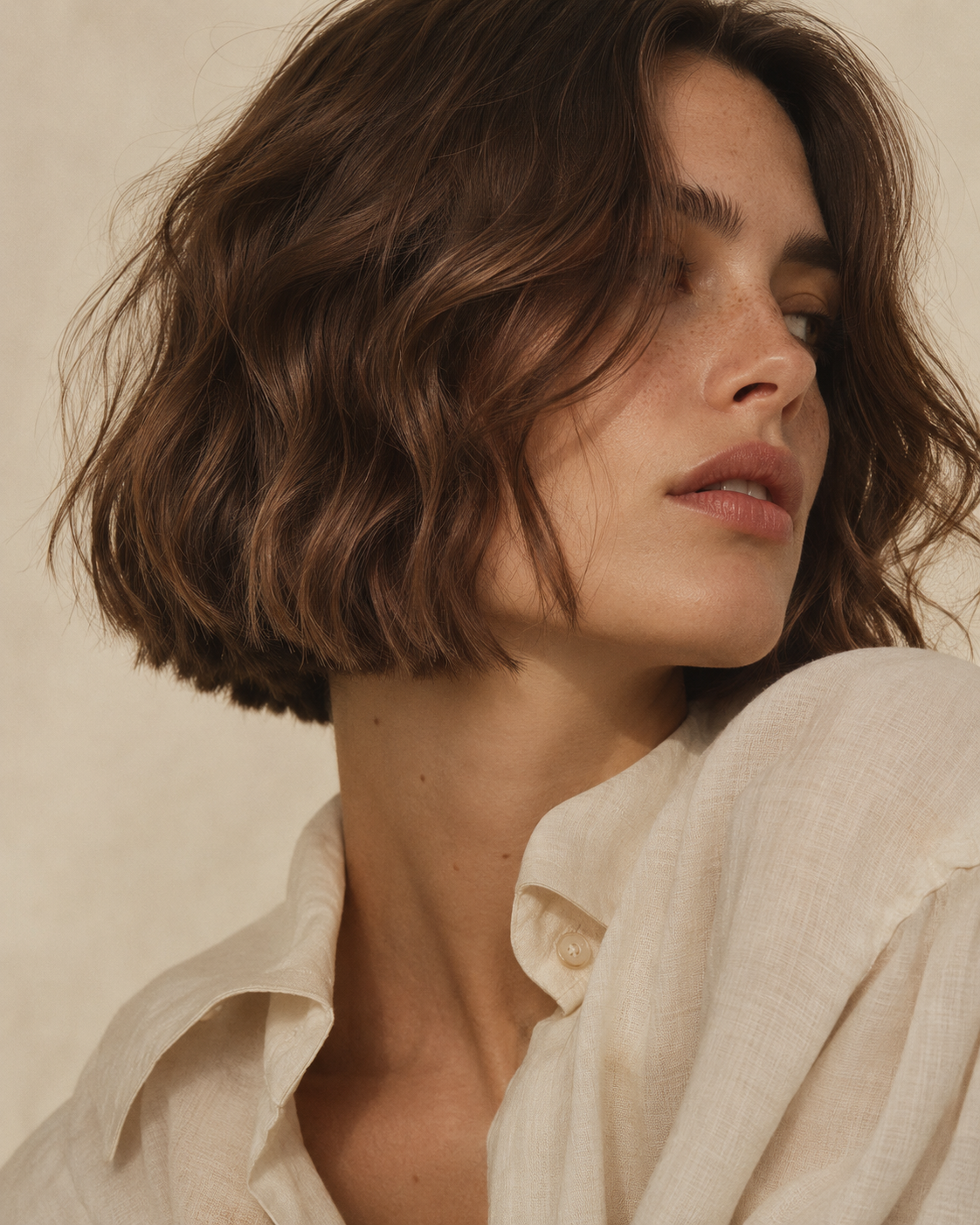
A boyfriend bob is a relaxed, slightly boxy short cut with a blunt-looking edge and minimal layers, usually falling from the chin toward the collarbone. It has structure without looking overly styled. Think of it as a bob that can move, bend and get a little messy on purpose.
The details make the difference: compare the different bob shapes, take a salon script to your appointment, and choose a quick styling routine that works with your own texture. Low effort still means finding a length and shape that cooperate with your hair.
What makes it a boyfriend bob?
Stylist Franck Izquierdo describes it to Who What Wear as a boxier, more relaxed take on the classic bob, generally cut near the chin or a little longer, with a blunt edge and minimal layering. Stylist Cody Renegar similarly describes a chin-to-collarbone length with a relaxed finish in the publication's fall hair guide. The shape is deliberate; the finish doesn't need to be immaculate.
A boyfriend bob is a useful choice if you like a strong outline but don't want a style that depends on a perfect blowout. The blunt edge gives the cut its visual weight; the relaxed styling keeps it from feeling too precise. It can look sleek one day and a little rumpled the next without becoming a different haircut.
That doesn't mean zero maintenance. Shorter hair can show a cowlick, a strong wave or a growing-out line more readily than longer hair. The best version is one your stylist shapes around those details, not one that asks you to fight them every morning.
Thanks for your feedback! Couldn't send feedback. Try again?
Report this addition
How to choose your length
The distance between your chin and collarbone offers several distinct looks. Before deciding, look at the cut from the side as well as the front and consider how your hair behaves when it dries.
Length
What to consider
Chin-length
Makes the outline especially noticeable and can give the bob a crisp, boxy feel. Check how it sits around your jaw and whether you can tuck the front behind your ears.
Below the chin
Leaves a little more room for movement and can feel less abrupt if you're new to short hair. The ends may still need attention if they flip against your neck.
Near the collarbone
Offers more length to experiment with and may be easier to gather back, depending on your hair. Ends that touch the shoulders can naturally kick out.
If you're undecided, start longer. You can always ask for another small cut during the appointment, but you can't put the length back. Stand up and look at your hair in your usual posture before the final decision: a centimeter can change where an edge lands.
Thanks for your feedback! Couldn't send feedback. Try again?
Report this addition
Boyfriend bob vs. other bobs
Cut
What sets it apart
Boyfriend bob
A fairly blunt perimeter, few layers and a relaxed, slightly boxy shape.
Izquierdo points to oval, round and heart-shaped faces and suggests adjusting the length or adding volume for a longer face. These are starting points, not rules. Look at where the ends will sit when your hair is dry, and choose the feature you want them to frame.
Waves can give the shape movement without much work. For fine hair, ask about retaining enough weight at the edge; for thick hair, discuss discreet internal shaping if the ends feel too heavy. Those are general consultation ideas, not guarantees. Curls can spring up considerably as they dry, so show your stylist your usual curl pattern and discuss dry length.
Thanks for your feedback! Couldn't send feedback. Try again?
Report this addition
Embrace your individuality and transform your look by trying out a unique shade. Did you know that green hair is associated with nature, creativity, and growth? So go ahead, experiment with this bold hair color to represent a new phase in your life, waiting to blossom like a fresh spring leaf.
How to adapt it to your texture
The following are conversation starters, not rules. Density, strand thickness, curl pattern and growth direction interact, so two people with “thick hair” may need different cuts.
Fine hair
Ask to keep a solid-looking edge if you want the ends to appear fuller. Too much visible layering or aggressive thinning can make the perimeter look sparse on some fine hair. A lightweight mousse at the roots or a small amount of texture spray through the lengths can add lift; start with less than you think you need and build only if necessary.
If your hair lies very straight, a strong side part, a slight bend made with a brush, or a little finger styling may give it movement. You don't need to add waves for the haircut to count: a straight, slightly imperfect finish works beautifully too.
Thick or dense hair
A blunt outline doesn't require every strand underneath to be the same length. Ask your stylist how to remove bulk discreetly while keeping the edge you like. Internal shaping can make a dense bob easier to wear, but the amount and placement should suit your hair; show your stylist where it tends to expand or stack.
Air-dry cream can help define the surface, while a rough-dry at the roots may make the shape easier to control. If your ends form a triangle you don't love, bring that up before the cut rather than assuming lots of short layers are the only solution.
Wavy hair
A natural bend gives this cut the relaxed finish it's known for. Discuss whether your stylist should assess the final shape dry, when the wave has returned, and show them the pattern you usually wear. A wave that starts at the cheek can create a different silhouette from one that starts at the ends.
Scrunch in a little mousse or light cream, let the hair dry with minimal handling, then loosen any crisp product cast with your hands. A slightly uneven bend is part of the charm; you don't have to make both sides match perfectly.
Curly and coily hair
The same strong outline can be adapted to curls and coils, but the finished shape will depend on curl size, density and shrinkage. Ask about the length you want when dry, and bring pictures of a bob on a similar curl pattern. Your stylist can plan the shape around your usual part and how much volume you enjoy.
If you alternate between wearing your hair natural and stretched, explain both routines. A shape that looks even in one state can sit differently in the other. Agree which finish is the priority, and leave room for the hair to spring up.
Thanks for your feedback! Couldn't send feedback. Try again?
Report this addition
Making the shape feel like you
Face-shape advice can be helpful vocabulary, but it isn't a test you have to pass. Instead of asking whether you are “allowed” a chin-length bob, decide what you want the cut to emphasize and where you like volume. A piece falling by the cheek, a tucked side or a softer part can change the effect without changing the entire haircut.
If you like fullness at the sides, ask how your natural texture can create it. If you prefer a longer line around the face, consider a length below the chin or slightly longer front pieces. Bring examples you actually like, rather than relying on a face-shape chart to make the choice for you.
Can you add bangs?
Yes. A full fringe makes the look more defined, while longer curtain or cheek-skimming pieces offer a softer frame. Tell your stylist whether you are willing to style fringe separately: the bob may air-dry easily while the shortest pieces need more attention. The Elinor haircut is another reference for softer face framing.
Center part, side part or no fixed part?
Izquierdo suggests a center part for the classic relaxed effect, but says an off-center part works too. Bring your natural part to the appointment and mention if you switch sides. A bob cut for a strict center part may sit differently when flipped over, so ask your stylist to check the shape both ways if flexibility matters to you.
Thanks for your feedback! Couldn't send feedback. Try again?
Report this addition
What to ask your stylist
Try: “I'd like a relaxed bob around my chin or a little longer, with a strong edge and just a little texture at the ends. I don't want lots of visible layers. Can we adapt the length and weight to how my hair dries?”
Bring two or three reference pictures with a similar texture to yours, including a side or back view if possible. Show your usual part and explain whether you air-dry, use heat, tuck hair behind your ears or need to tie it back. If you're considering fringe, compare it with the softer face framing in the Elinor haircut.
Before the first snip, make sure you and your stylist agree on these details:
Dry length: Point to where you want the front and back to end, and account for shrinkage or a wave.
The perimeter: Decide whether you like a solid edge or a softer, lightly textured line.
Weight: Explain where your hair tends to puff out, collapse or separate.
Your routine: Be honest about air-drying, heat styling, workouts and how often you want to visit the salon.
The practical bits: Ask whether your chosen length will tuck behind your ears or fit into a small ponytail. Test with your own hair rather than assuming.
If you're nervous about losing length, ask for a first pass that leaves a little extra. You can assess the outline together and adjust. And if your stylist recommends changing the reference, ask them to explain how the proposed shape will look on your texture and what it will require at home.
Thanks for your feedback! Couldn't send feedback. Try again?
Report this addition
A five-minute styling routine
Blot wet hair gently and part it in the middle or slightly off-center.
Work a small amount of light styling cream or mousse through the lengths; use less at the roots if your hair is fine.
Scrunch waves or encourage your natural bend with your fingers. Let it air-dry, or rough-dry with a dryer until mostly dry.
Once dry, loosen the ends with your fingers. A little texture spray is optional; stop before the hair feels coated.
Five minutes is hands-on time, not a promise that every texture will dry in five minutes. Use heat protection if you heat-style.
When you want a smoother finish
Apply heat protectant according to its directions, then dry the roots in the direction you want them to fall. Use a brush to guide the lengths under or straight, concentrating on the pieces that need it rather than perfecting every strand. Let the ends remain a little relaxed so the finish doesn't become overly rigid.
When you want more bend
On dry hair, twist a few face-framing sections loosely with your fingers and use a small amount of styling product, or use a heat tool with a heat protectant. Alternate the direction of bends and leave the last bit of the ends relatively straight for a less uniform effect. Allow the hair to cool before separating the sections with your fingers.
A quick second-day reset
Dampen only the pieces that have flattened or bent awkwardly. Repart, scrunch or guide them into place and let them dry. If roots feel oily, a small amount of dry shampoo can help; follow the product directions and brush or massage out visible residue. A light mist of water may be enough for waves or curls that simply need reshaping.
Thanks for your feedback! Couldn't send feedback. Try again?
Report this addition
Troubleshooting the shape
The ends flip out. If the hair rests on your shoulders, that bend may be a natural result of the length. Try leaning into the flip, smoothing it while drying, or ask your stylist whether a slightly shorter or longer length would suit your routine better.
It looks too triangular. Bring photos of the shape on a typical day and ask about where the weight sits. A stylist can discuss subtle internal shaping or another length; avoid cutting into the bulk yourself, since the wrong placement can make the outline harder to manage.
It looks flat. Check whether your products are too heavy and try applying them away from the roots. Change your part, lift the roots while drying, or ask whether the current length is weighing down your particular texture.
The two sides don't match. Different growth patterns and waves are normal. Your stylist can check the cut dry and adjust if necessary, but a perfectly symmetrical finish may require daily styling. Decide how much variation you actually mind.
The front won't stay tucked. Ask for a length that reaches comfortably behind your ear, or use a small pin while it grows. Short face-framing pieces can look lovely, but they aren't always compatible with a hands-free routine.
Thanks for your feedback! Couldn't send feedback. Try again?
Report this addition
How often does it need a trim?
A sharp perimeter becomes softer as it grows. Ask your stylist when to return based on your growth, texture and whether you prefer a crisp edge or a more grown-in shape. A shorter bob may require more frequent shaping than a collarbone-length version.
Growing it out
If you're moving from a bob to longer hair, expect the outline to change as it approaches the shoulders. Tell your stylist that retaining length is the goal, so they can focus on small shape adjustments rather than restoring the original short line. A clip, half-up style or intentional outward flip can make the in-between stage feel like a choice.
For someone growing out a pixie, the starting length at the nape and around the ears may differ considerably. Ask your stylist for a transition plan and which areas need time to catch up. You may get a bob-shaped outline in stages rather than in a single appointment.
Thanks for your feedback! Couldn't send feedback. Try again?
It's one variation: the relaxed finish, minimal visible layering and boxier shape distinguish it from a more polished, geometric bob.
Can fine or thick hair wear one?
Yes, with a tailored perimeter and weight distribution. Bring photos and talk through how your own hair behaves.
Does it need a center part?
No. A center part is one way to style it, but an off-center or natural part works too.
Is it a good first short haircut?
It can be, especially if you start closer to the collarbone. Discuss the shortest length you would feel comfortable with and whether tying it back matters before committing.
Does a boyfriend bob work with glasses?
It can. Bring your usual frames to the consultation so you can see where the front pieces sit against the arms and whether you like the balance around your face.
What is the difference between a boyfriend bob and a French bob?
A French bob is often shorter and may be paired with fringe, though both names cover variations. A boyfriend bob generally emphasizes a relaxed, boxier outline and minimal layering. Photos and a discussion of length are more useful than the name alone.
Will it make my hair look thicker?
A solid-looking edge can give the appearance of more weight at the ends, particularly on fine hair. Results depend on density, texture and the exact cut; it doesn't change the number or thickness of your strands.
Do I need to style it every day?
Not necessarily. The cut is intended to look relaxed, but your texture, cowlicks and desired finish determine how much work it takes. Ask for a shape that supports your actual routine.
Thanks for your feedback! Couldn't send feedback. Try again?
Report this addition
Feedback Junction
Where Thoughts and Opinions Converge
Keep exploring
Search AllWomenStalk for your next read.
Add allwomenstalk.com as a preferred source on Google to see more of our trusted coverage when you search.
Don't Miss the Latest Version
Get the latest stories, save favorites, and share with friends — all in one place.
Choose the look that feels most comfortable for reading.
Your choice is saved on this device only.
Read Allwomenstalk in the app
A calm, image-forward feed of fashion, beauty, wellness and relationship stories. Save your favourites and discover what fits your mood — all on your iPhone.


Feedback Junction
Where Thoughts and Opinions Converge